Sunday, January 25, 2015

New Horizons soon to reach Pluto

NASA photo
New Horizons is the NASA space probe that was sent to study the surface of Pluto and its moons in a flyby mission launched 19 January 2006. It is expected to reach the surface of the planet in July 2015.

Since the spacecraft is now getting close enough to start sending back first-ever photos of the planet and surrounding planetary bodies, this will be a fascinating topic for my engineering students this coming semester (my spring semester is from February to June). There are so many interesting aspects of New Horizons - relating to both the spacecraft and the mission itself - that teachers of ESP will certainly find something for their students.

The Time magazine website has an article written by Alan Stern, the American planetary scientist who is the principal investigator of the New Horizons mission. This article is not only a clear and concise introduction to the topic, but also has a lot of useful language for the ESP classroom.

Link to the article: http://time.com/3645704/pluto-new-horizons-spacecraft/

The article has vocabulary relevant to distance, time, amount, speed and, of course, items in the semantic field of "space exploration." There are also useful vocabulary items of comparisons and superlatives. For example:
  • too little is known
  • very much the Everest of planetary exploration
  • becoming the fastest spacecraft
  • about 10 times more quickly than the Apollo spacecraft
  • the equivalent to L.A. to New York in four minutes
  • ventured farther ... to reach
  • At its closest approach
  • still both the brightest and largest one known
  • the largest mapped structure
  • three times as big

For a fairly short article, there are quite a few tenses used:
  • present simple
  • present perfect
  • past simple
  • past progressive
  • future with will
  • future with going to

The sentences with the past simple tense and the present perfect tense are good examples of the differences between the use of these two tenses - something my students find difficult to understand.

past simple tense:
  •  The last time a spacecraft reached a new planet was during ... back in 1989.
  • New Horizons already set records when it was launched in 2006 ...
  • In 2003, the National Academy of Sciences ranked visiting the Pluto system ...
  • Because in the 1990s, planetary astronomers discovered a vast structure ...
present perfect tense:
  • I have had the privilege of leading ... since its inception 14 years ago ...
  • No spacecraft has ever ventured farther ...
  • Nothing like (it) has happened in a generation ...

In the article, Alan Stern mentions the questions about Pluto that the mission is expected to answer. These are not only useful for follow-up research work for students, but are also good examples of the variety of question forms in English:
  • Does it have mountain ranges?
  • Is its surface young or old?
  • Are there polar ice caps?
  • Might there be liquids on its surface or oceans in its interior?
  • Could there be cloud decks in its atmosphere?
  • Erupting geysers?
  • Does it have more moons yet to be discovered?
He says, "We don't know the answers to any of these questions - but we should know all of them soon." These questions can be the basis of further work students could do to find the answers to these questions as the mission progresses.

For further work, there is also a New Horizons website (in conjunction with both NASA and Johns Hopkins Applied Physics Laboratory) with updates:

Home page: http://pluto.jhuapl.edu/index.php

Alan Stern himself writes updates about the New Horizon mission here; the latest was on 23 January. Students can keep checking the updates here to learn about New Horizons' progress.

http://pluto.jhuapl.edu/overview/piPerspective.php?page=piPerspective_01_23_2015

On this particular update, he lists the objectives of the flyby as:
  • Determine how Pluto's atmospheric pressure and temperature vary from the surface to high altitude.
  • Determine the atmosphere's complete composition.
  • Measure the atmospheric escape rate.
  • Determine if Pluto has an ionosphere.
  • Determine how Pluto's atmosphere varies from place to place, and with seasons and time of day.
  • Search for an atmosphere at Charon.

Students can follow the progress of the mission by focusing on the particular area they are most interested in. In addition to (or instead of) these objectives, students can focus on the specific instruments and technology on the spacecraft - what they are, what their purpose is, and how they function.

In my next post I'll focus specifically on the technology of the payload on New Horizons - something that my robotics engineering and mechanical engineering students are particularly interested in.

Sunday, January 18, 2015

Making students aware of their "Life on Earth"

Add your data
Your Life on Earth is an interactive feature on the BBC website. Enter data about your birth date, gender and height and you can see how various aspects of the world have changed since you were born.

The link: http://www.bbc.com/earth/story/20141016-your-life-on-earth

From the website:

"Find out how, since the date of your birth, your life has progressed, including how many times your heart has beaten, and how far you have travelled through space.

Investigate how the world around you has changed since you've been alive; from the amount the sea has risen, and the tectonic plates have moved, to the number of earthquakes and volcanoes that have erupted.

Grasp the impact we've had on the planet in your lifetime; from how much fuel and food we've used to the species we've discovered and endangered."

The material comes from the archive of BBC shows and documentaries - many of which have example clips in the area below the display. The 3 areas focused on are "How you have changed," "How the world has changed," and "How we have changed the world."

As an example, a female student of mine who was born in 1988 and is 173 cm. tall (5`8") found out that:
  • she has had 1 billion heartbeats in her lifetime so far (in comparison with a blue whale, whose heart would have beaten 83 million times or a hummingbird with 18 billion heartbeats);
  • she would be 107 years old on Mercury, and her next birthday there would be in 17 Earth days from today - while on Jupiter she would be only 2 years old (with a birthday in 3,339 Earth days);
  • she has been around the sun more than 25,037,712,000 km (constantly updating as you watch);
  • a penguin her age would have had 5 generations by now, a rabbit 52 generations, a killer whale 1 generation, etc.;
  • and that life expectancy has increased 5.7 years since she was born.
There are also data for other changes in the world and -- perhaps more importantly for our students -- how humans have changed the world.

These changes include:
  • sea level and ocean pH levels;
  • animals, fish and plants under threat of extinction;
  • food and drink supplies per person;
  • power supply;
  • emission control;
  • etc.
The area that most interested my students, and caused the most discussion, was Fuel Gauge: How old will you be when resources run out? For this student - and for many in this particular group - the answers were:
  • oil - 79 years old
  • coal - 81 years old
  • gas - 139 years old
The reality that it will be a particular year in their lifetimes if nothing changes in the way we use resources - and the resources we use - was quite eye-opening for them. Although many felt that "something" would change before they reached that age, it still gave them a certain deadline to think about.

With other, younger, groups it could be even more revealing. This made the statistics and information about sustainability really have a personal meaning for my students.

Wednesday, January 14, 2015

Relevant Links

I've added a new feature to this blog: Relevant Links. It's located at the right, underneath Search This Blog. In the process of finding useful material, I often come across other blogs and websites that regularly add material that's interesting for those of us who teach English to engineers and engineering students - or to the engineers and students themselves.

My first link is: Engineering Ethics Blog.

Here's the link also: http://engineeringethicsblog.blogspot.co.at/

The blogger has worked in industry and as an engineer, and is now a teacher of college-level engineering at an American university.

This is what he says in the section About the Engineering Ethics Blog:

"A good engineer both does things right, and does the right thing.  Doing things right is what engineers learn from the technical parts of an engineering education:  classes on differential equations, lab experiments that demonstrate how materials perform, and so on.  Doing the right thing, on the other hand, is not just a technical problem.  It has to do with questions like ‘Who will buy this product? What will they do with it?  Could it hurt anybody?  Was anyone treated unfairly during the development process?’

These types of questions draw upon more than technical knowledge (though technical knowledge is vital)—they test an engineer's character.  And these types of questions—questions about how to do the right thing and avoid the wrong thing in engineering—are what engineering ethics is about.”

He explains: “In this blog, I take a much broader view of engineering ethics, and deal with subjects as diverse as disasters that involve technical matters, movies with an engineering ethics or technical angle, and even philosophical and religious questions that engineers might have to deal with.”

Many of his posts might be rather long for students at a lower level, but for students who are able to read articles from such newspapers as The Guardian, The Independent, The New York Times and Time magazine (which I've used on my blog), there shouldn't be a problem.

For teachers, there's useful material for creating lessons with discussions and research work. For example, in Popular Posts by Category there is a section "Disasters." In classes in Engineering Ethics, I've had students read about disasters involving engineering decisions or mistakes, and then discuss the implications for responsibility.

Other topics in this section are "Book reviews," "Engineering ethics (general)," "Humor," and "Movie reviews."

I wish he had more movies with an engineering or technical angle - he has only The Bridge on the River Kwai and The Prestige. In fact, The Bridge on the River Kwai is a film included in Engineering Ethics courses at my university (and it's great), but there are many more films that are also relevant to specific areas of engineering.

It would be interesting to get comments with ideas for films that illustrate some aspect of engineering ethics - and then I could write about them in a future post.

In the meantime, it's worthwhile to check out the Engineering Ethics Blog - for interesting reading and for useful material for teaching English to engineers.

Saturday, January 3, 2015

Competition for Grand Challenges in Engineering

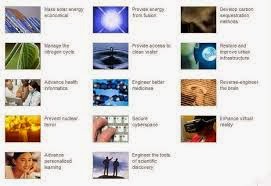
The 14 Grand Challenges
Engineering students will have a chance to compete alone or with colleagues by creating a video that focuses on achieving a "Grand Challenge." They'll not only have the satisfaction of receiving acknowledgement for their great ideas, but they can win a lot of money as well!

The National Academy of Engineering (NAE) is sponsoring a contest, Engineering for You 2 Video Contest, for which the grand prize is US$25,000.The competition opens in 2 days - 5 January 2015 - and the deadline is 2 March 2015 (noon U.S. Eastern Standard Time).

It is open to individuals or teams in the following four categories:
  1. Middle School Students and Younger (grades K-8)
  2. High School Students (grades 9-12)
  3. Tertiary Education Students (2-year college through graduate school, part- or full-time
  4. The General Public

The NAE has outlined 14 areas of what it calls "Grand Challenges for Engineering." Competitors must choose one or more of these challenges and then create and submit a 1- to 2-minute video "that shows how achieving one or more of the NAE Grand Challenges for Engineering will lead to a more sustainable, healthy, secure, and/or joyous world!"

The information on NAE's website: https://www.nae.edu/e4u2/

The 14 Grand Challenges (in no particular order) are:
  • Make solar energy economical
  • Provide energy from fusion
  • Develop carbon sequestration methods
  • Manage the nitrogen cycle
  • Provide access to clean water
  • Restore and improve urban infrastructure
  • Advance health informatics
  • Engineer better medicines
  • Reverse-engineer the brain
  • Prevent nuclear terror
  • Secure cyberspace
  • Enhance virtual reality
  • Advance personalized learning
  • Engineer the tools of scientific discovery 

Students would certainly be motivated to create something and enter the competition. Even if they don't win, they'll come up with useful ideas and they'll certainly have great practice in language skills, teamwork and creativity. And if they win - well, there's the glory and some money!

More specific information about the videos is on the competition website:
http://www.engineeringchallenges.org/  

The winners and prizes will be announced in September 2015, and I'll give an update in another post then.

Sunday, December 28, 2014

Greatest Engineering Achievements of the 20th Century

Image from website
At the end of the year I like to gather information about the year's "greatest" inventions and innovations, and focus on those that are from the engineering fields of my students.

Last year I wrote about the top 5 finalists of the Engadget Insert Coin Competition (Posts from 29 December 2013 to 27 January 2014). The year before I wrote about Time magazine's "Best Inventions of the Year" (24 December 2012), which they publish every year in December.

This year, I decided to use information from a website created by the National Academy of Engineering (NAE), which has listed - and given information for - their choices for the 20 greatest engineering achievements of the 20th century.

The website: http://www.greatachievements.org/

The information is based on the book, A Century of Innovation: Twenty Engineering Achievements That Transformed Our Lives, by George Constable and Bob Somerville (2003).

Students can first brainstorm what they think the twenty greatest achievements were, and can discuss their choices. Many - if not most - of their choices will certainly be on the NAE's list.

These achievements are:
  1. Electrification
  2. Automobile
  3. Airplane
  4. Water supply and distribution
  5. Electronics
  6. Radio and Television
  7. Agricultural mechanization
  8. Computers
  9. Telephone
  10. Air conditioning and refrigeration
  11. Highways
  12. Spacecraft
  13. Internet
  14. Imaging
  15. Household appliances
  16. Health technologies
  17. Petroleum and petrochemical technologies
  18. Laser and fiber optics
  19. Nuclear technologies
  20. High-performance materials

For each achievement, there is a Timeline spanning the development from invention to present day, separate sections of information about the achievement, and an Essay written by an engineer from the field of achievement.

This last resource is particularly useful for students, since the essays can serve as models for students' own writing: about the history of an innovation, the impacts of the innovation, or as an overview of an innovation in their engineering field.

The material on the website is also very useful for reading skills, since students will certainly be motivated to read about an achievement of their choice.

Tuesday, December 23, 2014

Animated Engines

The Two Stroke Engine
In my last post I wrote about the website 507 Mechanical Movements, created and maintained by Matt Keveney.

He has also created a related website, Animated Engines, which is just as interesting and especially useful for engineering students.

The website: http://www.animatedengines.com


The Home page has 21 engines:
  • Four Stroke
  • Diesel
  • Two Stroke
  • Wankel 
  • Atkinson 
  • Gnome Rotary 
  • Jet Propulsion 
  • Steam Locomotive 
  • Oscillating Steam 
  • CO2 Motor 
  • Coomber 
  • Crank Substitute 
  • Revolving Cylinder 
  • Watt Beam 
  • Grasshopper Beam 
  • Unknown Beam 
  • Newcomen Atmospheric 
  • Two Cylinder Stirling 
  • Single Cylinder Stirling 
  • Ross Yoke Stirling 
  • Low Differential Stirling

Each illustration leads to a separate page on which the engine is animated (in color), with an insert to control the speed of the animation, or to stop it. What is particularly useful (in addition to the animation itself) is further explanation of how the engine works.

For example, the Two Stroke Engine page first has the explanation, "The two stroke engine employs both the crankcase and the cylinder to achieve all the elements of the Otto cycle in only two strokes of the piston." Then separate aspects are explained and illustrated:
  • intake
  • crankcase compression
  • transfer/exhaust
  • compression
  • power

Each of these aspects has a short description. For example, for intake:

"The fuel/air mixture is first drawn into the crankcase by the vacuum that is created during the upward stroke of the piston. The illustrated engine features a poppet intake valve; however, many engines use a rotary valve incorporated into the crankshaft."

In this short extract, there is the use of the passive (is first drawn into; the vacuum that is created), linking (first; during; however), topic-related technical vocabulary (fuel/air mixture; crankcase; vacuum; upward stroke; piston; poppet intake valve; rotary; crankshaft), and useful collocations (drawn into; vacuum created; upward stroke; incorporated into).

The entire explanation for this one engine is, of course, even more useful for engineering students as a model example of a process description that they can emulate in their own writing or presentations.

In addition to the engines, the website has a "How To" section in which Mr. Keveney explains how he makes these animations. Although he warns that, "What follows is only an outline. Please understand that this is not a complete tutorial," his explanation is in itself a useful process description (with step-by-step illustrations). Students who are interested in knowing more about how the animations are created can sign up for an update to be notified when Matt Keveney documents this technique.

Saturday, December 13, 2014

507 Mechanical Movements - animated

A page from the book on the website
The homepage of the website 507 Mechanical Movements explains that "This is an online edition of the classic technical reference "Five Hundred and Seven Mechanical Movements" by Henry T. Brown.

This site contains the original illustrations and text from the 21st edition of the book, published in 1908. It also includes animated versions of the illustrations, and occasional notes by the webmaster."

The webmaster is Matt Keveney, who has developed the animated versions of the illustrated movements, and is still working on them. The website says that the "animated versions are not yet complete." The ones that are complete are in color. Visitors to the site can follow the developments by subscribing to the website.

Link to website: http://507movements.com/

This seems like a great resource for mechanical engineering students, as well as students of other engineering disciplines. I myself found the movement of the images hypnotic. There is a certain beauty in the precision of the movements.

Underneath each image is a short description of the movement and how it works. These short texts provide a model description of the movement shown, and could help students describe the features of machines that incorporate these movements. The specific vocabulary of movements is also very useful.

For example, these are the descriptions of two of the movements (I chose them because I found them particularly lovely to watch!):

  • #123 (substitutes for the crank): Intended as a substitute for the crank. Reciprocating rectilinear motion of the double rack gives a continuous rotary motion to the center gear. The teeth on the rack act upon those of the two semi-circular toothed sectors, and the spur-gears attached to the sectors operate upon the center gear. The two stops on the rack shown by dotted lines are caught by the curved piece on the center gear, and lead the toothed sectors alternately into gear with the double rack.

  •  #145 (cranks): Reciprocating curvilinear motion of the beam gives a continuous rotary motion to the crank and fly-wheel. The small standard at the right, to which is attached one end of the lever with which the beam is connected by the connecting-rod, has a horizontal reciprocating rectilinear movement.

There is an alphabetical index of the movements, as well as "thumbnails," which show 9 related movements on one page. A user can also move through the images one by one.

I plan to recommend this website to my students in preparation for their process description presentations, and also because I think they'll enjoy it as much as I do!

Monday, December 8, 2014

Two-year anniversary of this blog

It's now been 2 years since I started this blog (on November 30, 2012) and the reasons I started it are still valid today. Here are 3 reasons I mention in the About this blog section:
(1)  There are many textbooks available for engineering students learning English, but it's difficult to find one with material specifically focused on my students' particular technical areas.
(2)  Much of the language material on the web seems to focus on grammar and vocabulary skills in general, rather than the kind of language features my students encounter in their technical reading and writing.
(3)  I want to share the material I find with other English teachers who are working with students in technical areas, and to give those teachers a place to contribute what they find useful.
It is still difficult to find published material that is relevant for specific technical areas -- I think this is a major issue for ESP teachers in general.

And I still work with more than the "grammar and vocabulary" areas in the classroom, and when I do focus on language skills, I try to connect them to my students' specific engineering areas.

But over the past 2 years, I have started teaching in more engineering areas.

I started teaching ESP (as distinct from EAP - English for Academic Purposes) with classes for students of electronics engineering and of computer science. Then I had groups in mechatronics and robotics engineering and in biomedical engineering. When I started this blog, those were the groups I focused on.

Since then I have also been teaching students of international business engineering and of mechanical engineering. And in each of these areas, the levels have ranged from low-intermediate to advanced.

So my interest in finding relevant articles, videos, websites and other material that will engage my students keeps expanding.

It would be interesting to get input from readers of this blog to find out what areas of engineering your students are studying, and what kind of material you find most useful.

Saturday, November 22, 2014

The ethics of robots

Isaac Asimov, a professor of biochemistry and a prolific author of science fiction and science books, introduced what is known as "The Three Laws of Robotics" in his short story "Runaround" - the first story in the collection I, Robot, 1942. The three laws are:
  1. A robot may not injure a human being or, through inaction, allow a human being to come to harm.
  2. A robot must obey the orders given to it by human beings, except where such orders would conflict with the First Law.
  3. A robot must protect its own existence as long as such protection does not conflict with the First or Second Law.
He added another law, which precedes the first three:

0. A robot may not harm humanity or, by inaction, allow humanity to come to harm.

Today robots of all kinds are part of business, manufacturing, medical care, and almost all areas of society, so having a focus on ethical guidelines is even more important than when Asimov wrote his stories.

The problem with these laws today, however, is that they focus on the behavior of the robot -- instead of the behavior of the robotics engineer.

In considering the ethics of robots and robotics, there must also be a focus on the laws that are in place to ensure ethical behavior on the part of the engineers designing and building robots. However, it seems that laws have not yet advanced to the level of the robotics systems being built.

These considerations are the focus of a talk called "Robotics and the Law," given by Kate Darling, a Research Specialist at the MIT Media Lab. The talk is part of the Lightning Presentations available on FORA-TV.

The video (7:14): http://fora.tv/2013/11/20/Lightning_Presentations_Round_2

I wrote about FORA-TV in my blog of 3 November 2013 ("Great source of videos for the classroom") as an excellent source of short videos about many technical and engineering topics - as well as other topic areas.

The areas she focuses on in the video, which she calls the 3 issues, are:
  • safety
  • privacy
  • social issues
In class discussions about this talk, my students have agreed that these three issues are also relevant to all the areas of engineering they could think of. So there's a lot of material here for the classroom.

Kate Darling
Kate Darling is an extremely interesting speaker - not only is she lively and well-spoken, but she is also passionate about her topic. And it shows. On the website "about.me," her description heading is: Mistress of Machines. Robot Ethics. Intellectual Property.

The description of her says:

"Research Specialist at MIT Media Lab. Fellow at the Harvard Berkman Center for Internet & Society and the Yale Information Society Project. Survived law school. Holds a doctorate in sciences. Passionate about the near-term societal impact of robotic technology, rethinking copyright and patent law, and caffeinated beverages."

http://about.me/katedarling

My students love this description, since it makes her sound very human, and very interesting.

Saturday, November 8, 2014

World-changing ideas summit

"Imagination is more important than knowledge." - Albert Einstein

If we agree with Einstein, then the presentations at this summit will certainly serve as inspiration to students in any engineering area. On October 21, 2014 BBC Future presented "the first-ever World-Changing Ideas Summit, which will showcase the power of bringing forward-thinking leaders together to build a better tomorrow. Big ideas and major challenges in science, technology and health will be discussed by top minds."

Event website: http://www.worldchangingideassummit.com/

BBC Future website page with article announcing the summit:
http://www.bbc.com/future/story/20140917-ideas-that-will-change-the-world

The talks presented at the summit were filmed, and a number of them are now available on the BBC Future website: http://www.bbc.com/future/columns/world-changing-ideas

The talks available so far cover a wide variety of interests and engineering areas, and would probably appeal to most students.

1)  Everybody spies, or nobody does (5:19) - Bruce Schneier, Security Technologist & Chief Technical Officer, Co3 Systems Inc. He talks about why we need to choose between security and surveillance, saying that we can only build technologies that are secure for all users, or are vulnerable to all attackers.

2)  The future of the internet (18:50) - Julius Genachowski, former Chairman of the Federal Communications Commission and current Managing Director and partner at The Carlyle Group. He discusses what the future of the internet is: dark web, regulation, privacy ...?

3)  Is a robot world good for us? (17:54) - Kate Darling of MIT, Heather Knight of Carnegie Mellon Robotics Institute, Andrea Thomaz of Georgia Institute of Technology, and Fernando Orellana of Union College discuss the question of how we will relate to tomorrow's robots.

4)  Empowering the next generation of world-changing ideas (19:33) - Alfred Spector, Google's Vice-President of Research. He discusses the benefits of schooling fuelled by technology, and asks: In a world where information is all around us, how do we educate the next generation of innovators?

5)  Can Tech create a new Renaissance? (8:15) - Alexis Ohanian, Reddit founder, describes the internet's next big trend, citing everything from "To Kill a Mockingbird" to lolcats.

6)  Why colonize other planets? (6:44) - Jeffrey Hoffman, a retired astronaut who spent more than 50 days in orbit on NASA missions. He discusses the challenges facing space colonists.

7)  Why everybody needs a drone (9:07) - Mary "Missy" Cummings, former fighter pilot and current Director of Humans and Autonomy Laboratory, Duke University. Could drones allow us all to become pilots? Missy Cummings says they are a vital step that brings us closer to a world with flying cars.

8)  Just because we can live longer doesn't mean we should (24:35) - Ezekiel Emanuel, physician and bioethicist. He doesn't want to live past 75, and explains why he thinks extending later life is wrong.

The presentations are of varying lengths, but each one is presented clearly, with relevant visuals. Students can either choose which one they want to watch on their own - and report the information to the group - or choose one to watch together as a basis for discussion.